Are Search Engine Rank Tracking and AI Prompt Tracking Actually Helpful in 2026?
With Google adding AI answers to search results and more people using AI tools like ChatGPT, Gemini, and Claude, you may be wondering whether tracking your search engine rankings is still worth the effort.
In short, yes, search engine rank tracking can still be helpful in 2026. Tracking your rankings on search engines like Google gives your business a baseline for understanding visibility for important keywords and evaluating progress over time.
However, rankings should only be one part of your measurement strategy.
In this article, I outline my recommendations for approaching rank tracking without getting stuck in weeds of obsessing over reporting. Note that our best practice recommendations are based on our fifteen years of experience working with hundreds of companies at Igniting Business, as well as third-party research data from experts that we trust.
Table of Contents
Why Search Engine Rank Tracking Still Matters
Rank tracking monitors where your website or business listing (e.g. Google Business Profile) appear for target search queries. The search queries you monitor should reflect the products, services, and locations that matter to your business and that your target audience frequently searches.
For example, an estate planning law firm might track “estate planning lawyer near me” or “estate planning attorneys” in the cities or zip codes it serves. Ranking for that phrase is likely more useful than ranking for low-intent or too broad of query that attracts a volume of visitors who will never become customers.
Tracking relevant keywords consistently can help you:
- Establish a baseline before investing in SEO or making major changes to your website or online presence.
- See whether visibility improves after updating service pages or publishing helpful content.
- Identify services or locations where competitors consistently appear ahead of you.
- Recognize sustained declines or plateaus of progress that warrant further investigation or changes to your SEO initiatives.
Imagine your website drops from position 24 to position 11 for a valuable service over several months. That improvement might not generate a flood of leads immediately, but it gives you a reason to investigate what is working and where additional improvements could help get it to the top of page 1 which could have a significant impact on lead volume.
Without historical tracking, you lose that context. Checking Google occasionally gives you isolated snapshots, making it harder to distinguish progress from an unusually good or bad day. Additionally, if you try to “self-check” your own company’s rankings on your device, your results will be biased based on your proximity to the business location, past search history, if you’ve visited the website before, etc.
Just remember that a ranking improvement alone does not necessarily yield more leads. Nor does it prove which change caused the movement. Competitors, search engine updates, the natural lag effect of SEO, and other factors can influence the results. However, rank tracking can still help inform decisions about SEO priorities and marketing dollars.
Understand the Limitations of Rank Tracking
There are numerous limitations of rank tracking that you absolutely must understand.
Your Customers May See Different Results
Your ranking report is a benchmark for particular search conditions. It is not a promise that every customer sees your business in the exact same position. In addition to location, Google explains that personalization can affect search results. Location and other contextual factors can also change results, even when personalization is disabled.

For a local business, this distinction is especially important. Someone searching near your business location will see different map results than someone a couple of miles away.
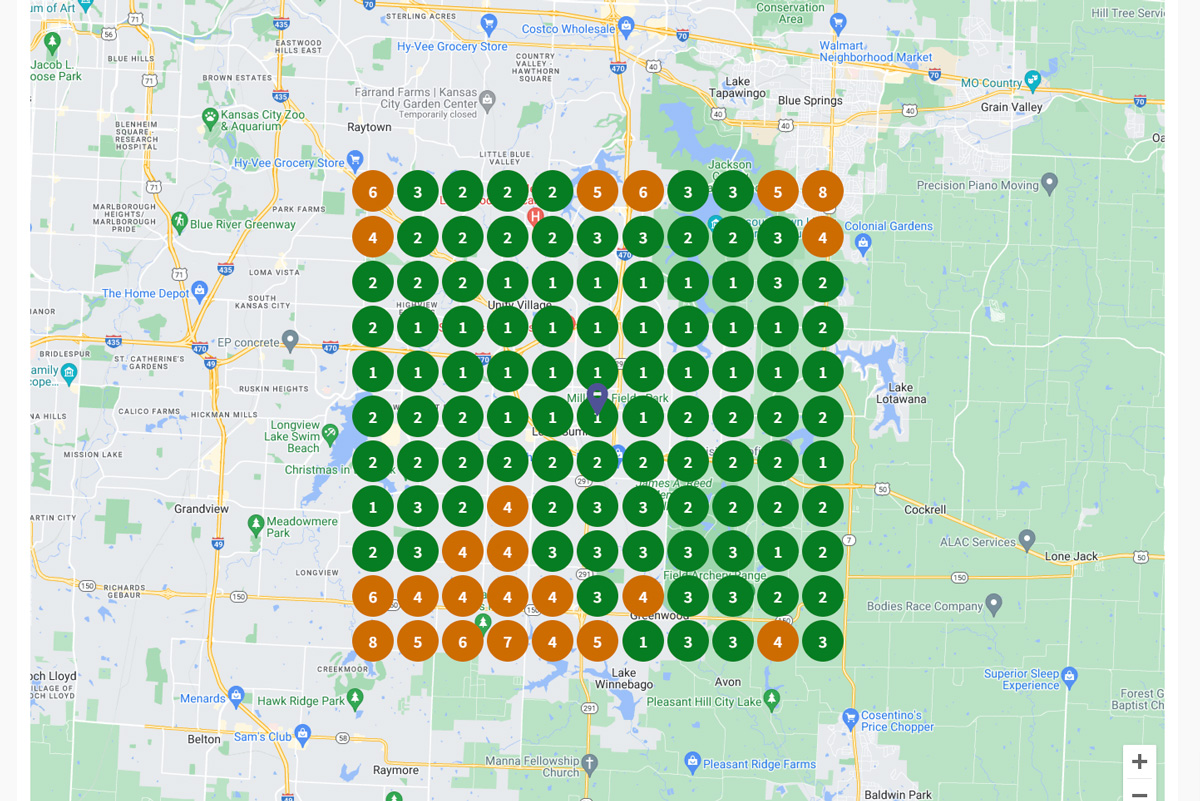
Make sure your tracking reflects the key locations you actually want to target. Tools that check rankings across multiple points on a map can help reveal those differences for local SEO purposes.
Rankings Fluctuate
Search engines change, competitors improve their online presence, and results naturally shift. That makes tracking a consistent trend more helpful than reacting to every individual position change.
If one keyword slips two spots for a week or two, I would not immediately overhaul the pages focused on that service or product line. If a group of important service keywords declines consistently over multiple months, that deserves a closer look.
Traditional Rank Tracking Does Not Always Show the Whole Search Results Page
Organic results, local map pack results, and AI answers can affect how prominently your website appears and whether someone clicks.
Do not assume your traditional rank tracker measures every map pack or AI feature within a search engine result page (SERP). Check which search features your tracking tool reports and whether map reporting or AI mentions and citations require separate tracking.
Should You Track AI Citations and Prompts
AI visibility tracking can be useful, but it requires a distinct set of expectations.
A prompt is the question or request someone enters into an AI tool like ChatGPT, Claude, Gemini, etc. These prompts tend to be longer than traditional searches performed in a search engine like Google.
A brand mention occurs when the AI answer names your business. A citation identifies a source used or linked in the response, which might be your website or a third-party website discussing your business.
Typically, a prompt tracker runs selected questions and records the responses. Think of this as a simulation of potential customer searches. It does not tell you exactly what every real customer asked or saw. Additionally, there is no publicly available AI platform-specific data that shows how many times a prompt is searched within AI systems. As a result, it can be challenging to pick which prompts to track.
Additionally, AI conversations allow people to provide detailed requirements and ask follow-up questions. Depending on the platform and settings, previous conversations or saved preferences may influence the response. Even repeating the same prompt can produce different recommendations.
Studies Show How Frequently AI Tool Answers Change
Recent studies help explain both the variability of AI answers and the consistency some brands maintain:
Detailed, September 23, 2026: Glen Allsopp analyzed over 70,000 responses across 28 days. For the typical prompt, identical brand sets appeared in just 0.3% of pairs of days on ChatGPT and 1.1% on Google AI Overviews. Only about a quarter of ChatGPT’s cited pages reappeared the next day, versus around half for AI Overviews. However, the most frequently mentioned brand appeared on 82% and 89% of days, respectively. The full list could change while a familiar brand remained. Exact-set matching is also strict: changing one name makes the set a mismatch, and name variations explain some apparent changes.
SparkToro and Gumshoe, January 2026: Across 2,961 responses, the researchers reported a less than 1-in-100 chance of ChatGPT or Google’s AI returning the same brand list in two responses to the same prompt. Yet individual brands could recur: SmartSites appeared in 85 of 95 Google AI responses to a prompt seeking digital marketing consultants with e-commerce expertise. Testing used participants’ normal settings in November and December 2025, capturing variation across users as well as repeated requests.
Ahrefs, November 2025: Researchers studied more than 43,000 keywords with repeated Google AI Overview observations over a month. Content changed between consecutive observations 70% of the time, while cited URLs overlapped by 54.5% on average. Named entities, including brands, people, and places, had 54% overlap, and the overall meaning remained highly consistent. Answers could change their wording and some sources without changing every subject they mentioned.
These studies measured different aspects of prompt tracking, so their percentages are not directly comparable. Naturally, even the LLMs measured are rapidly evolving as new models emerge or existing systems are updated. However, all three studies show why one AI answer should not be treated as a fixed ranking, while also showing that some brands maintain a recurring presence.
If you use AI tracking, understand the limitations and look at changes across repeated checks and whether your business appears consistently for relevant questions.
When AI Tracking Can Be Useful
If you have the budget for AI prompt tracking and understand the limitations, I would focus on three recurring patterns:
- Does your business appear across relevant questions?
- Which competitors show up frequently?
- Which websites does AI cite when discussing your services or products?
Those citations can reveal useful places to investigate. For example, the citations could identify an industry directory where your information is missing/outdated or a comparison article that overlooks your business but mentions several of your competitors. Keep in mind, a citation is a clue, though, not a complete explanation of how the AI selected its answer.
There are dozens of legit vendors for prompt tracking. Several well-established and reputable SEO tools that offer AI prompt tracking options include:
- Semrush Prompt Tracking monitors visibility for selected prompts across supported AI platforms.
- Ahrefs Brand Radar helps explore brand mentions and citations and supports custom prompt tracking.
- BrightLocal Local AI Visibility focuses on how local businesses appear in AI answers.
Extensive AI monitoring can become more expensive than traditional search engine rank tracking, particularly when adding platforms, prompts, and frequent checks. However, some SEO rank tracking subscriptions include a limited allowance or built-in AI tracking. For example, BrightLocal currently includes Local AI Visibility in its existing plans which tends to be more budget-friendly. Point being, check what you already have before buying another subscription.
Most Importantly Track Conversions and Their Marketing Sources
While rank tracking can be helpful, it’s more important that you know whether your marketing efforts generate conversions (quality leads and sales).
A conversion might be a phone call, contact form submission, text message, or online purchase. Tracking the marketing source of each conversion helps you understand which campaigns bring those opportunities to your business.

At Igniting Business, we recommend WhatConverts for tracking leads and conversions. We use it for our own business and our clients. Using a platform agnostic conversion tracking tool can help track marketing efforts across SEO, Google Ads, Facebook and Instagram Ads, LinkedIn Ads, identifiable referrals from AI tools, and more.
The benefit of a platform-agnostic tool is having a shared view across marketing channels, instead of piecing together separate reports from each advertising platform’s unique tracking mechanism and reporting dashboard.
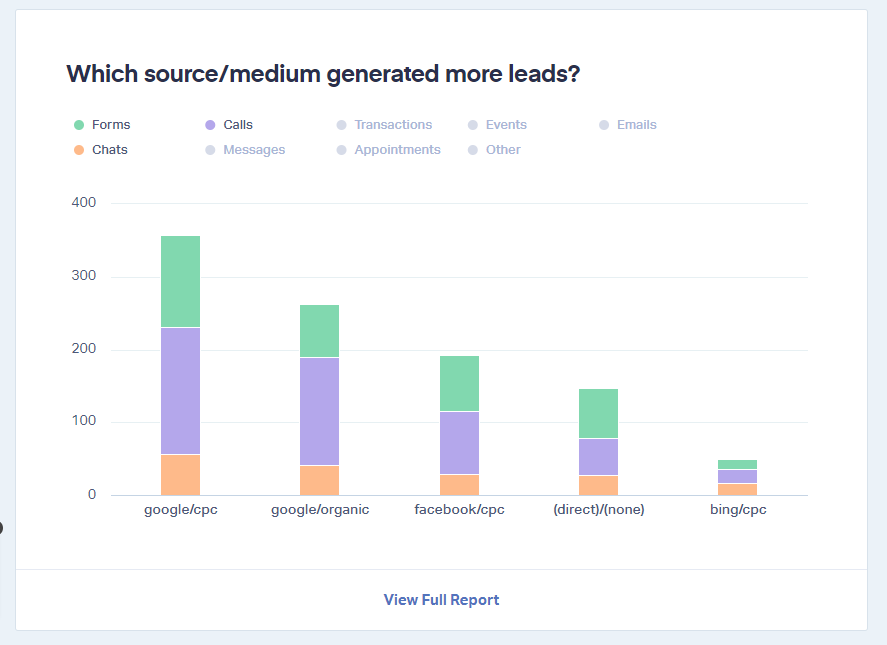
When configured correctly, WhatConverts can track phone calls, form submissions, text messages, live chats, appointment bookings, and e-commerce transactions. For phone calls, dynamic number insertion (DNI) displays a tracking number based on the visitor’s session or marketing source, helping connect the call to the marketing channel that brought them to your website. Our guide to phone call tracking explains how DNI works. We also cover how to track website form submissions on your website and using third-party lead forms.
Use Google Analytics to Measure Website Traffic
Google Analytics helps you see the visits your website actually receives, which channels bring visitors, and what those visitors do after arriving at an aggregate level.
Use Google Analytics data alongside rankings and conversion tracking can be useful. For example, if rankings improve but visits remain flat, investigate search demand for your target queries and how the search results page has changed. If visits increase but leads do not, review the relevance of the traffic and the user experience of your website and helpfulness of key pages being visited.
Google Search Console adds another perspective through search impressions, clicks, and queries. Google currently includes limited AI Overviews and AI Mode activity within its overall Web search performance reporting.
Track What Actually Matters to Your Business
In our opinion, search engine rank tracking still deserves a place in your marketing in 2026, especially if you’re spending marketing dollars on SEO. Start with important high-intent service and product keywords, track the locations you serve, and evaluate trends alongside traffic and qualified conversions.
If you need a starting point, give BrightLocal’s local rank tracking tools or Semrush Rank Tracking a try. Consider adding AI prompt tracking when it helps answer a specific business question and fits your budget.
Most importantly, implement robust conversion tracking so you can evaluate which marketing campaigns make a difference to your revenue versus which should be cut or budgets re-allocated.
For more practical marketing, SEO, and web design tips, subscribe to the free Igniting Business newsletter.
At no additional cost to you, we may receive a commission if you click on some of the links on this website and make a purchase.